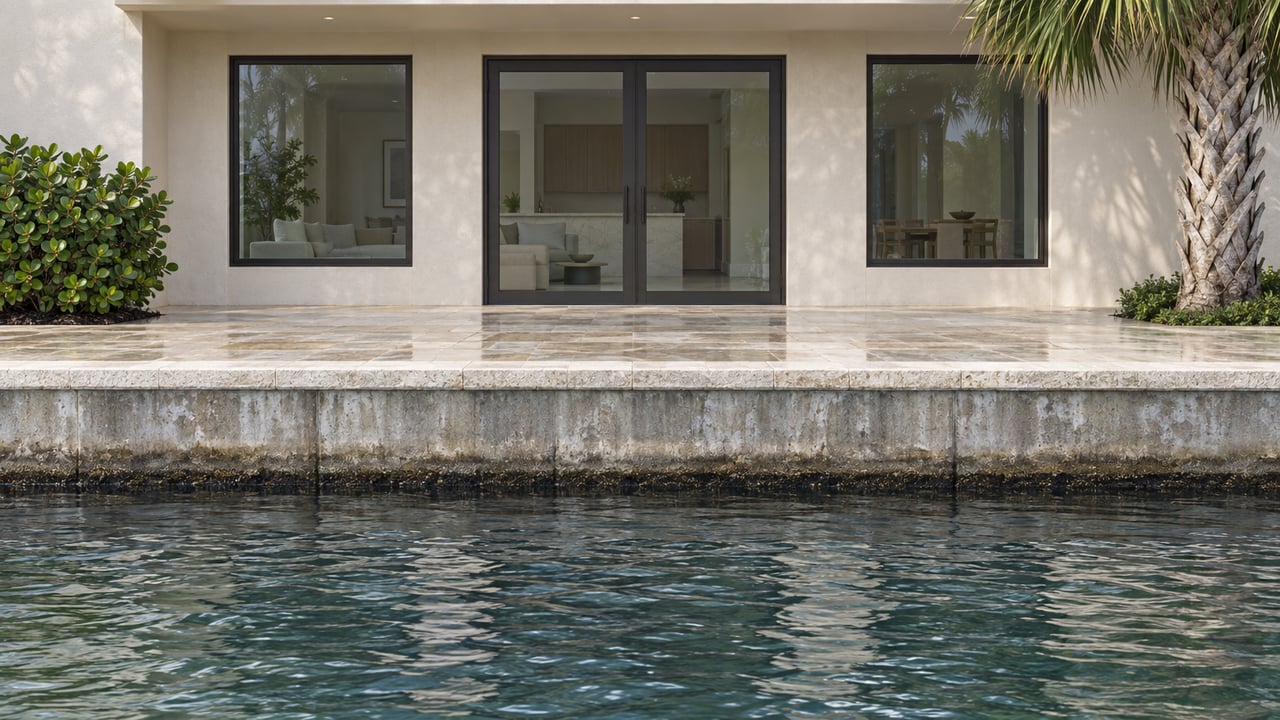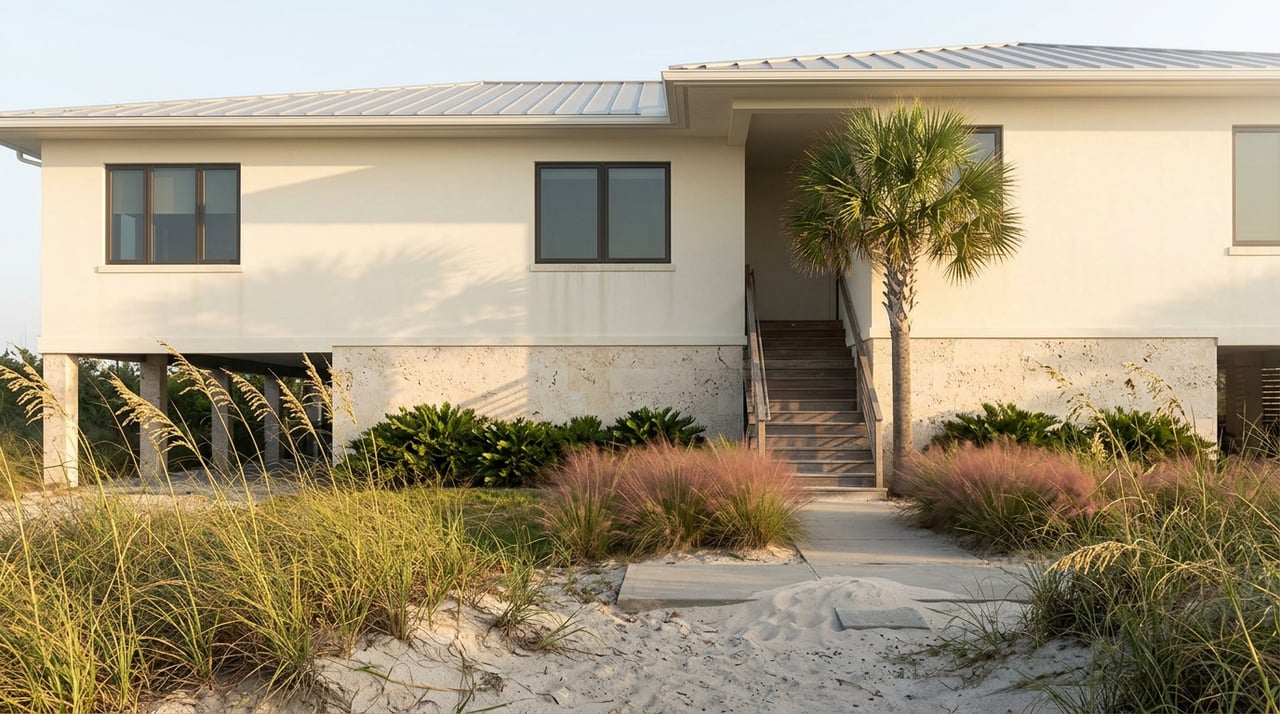
Ask a Siesta Key listing agent if a condo has been renovated, and the answer is almost always yes. New quartz counters, refreshed baths, a fresh coat of paint on walls that took on water two years ago. Ask what that renovation actually closed out with Sarasota County, and the conversation gets quieter.
That gap matters more on Siesta Key right now than it does almost anywhere else on the coast. The island's older beachfront buildings, many built between the 1960s and 1980s, spent 2025 and into 2026 working through a federal rule that decides whether storm repair stays cosmetic or becomes structural. A unit can look finished and still sit inside a building whose compliance file is not. For a buyer comparing renovated units this fall, that file, not the finish level, is where the real risk and the real leverage live.
The Building Has Two Renovation Stories, and Only One Shows Up in Photos
Federal flood rules require that when repair or improvement costs reach half of a structure's market value, not the land, the whole structure has to be brought up to current floodplain standards. On Siesta Key, where base flood elevation runs roughly seven to nine feet, that threshold has been the dividing line since the 2024 hurricane season between buildings that patched their way back and buildings that had to elevate, reinforce, or substantially rebuild.
Local reporting from Siesta Sand tracked what that looked like on the ground about six months after the storms. Palm Bay Club, which took heavy damage across 17 first-floor units, waited months for its initial permits. Its general manager, France Langan, put it plainly at the time:
"It seems they keep moving the goalposts."
Jamaica Royale got a permit for one building roughly two months after applying, while paperwork for three more buildings sat in limbo. At Siesta Harbor, a 168-unit complex where 42 ground-floor units flooded, longtime resident Tom Surprise said the rebuild he expected to take six months was going to take longer. At Aloha Kai Condominium, the general manager, a former contractor himself, noted that plenty of contractors were still learning the county's documentation requirements, which led to rejected applications. Sarasota County rejected more than half of all permit applications in the early months of the recovery, mostly for missing or incorrect paperwork, before approval rates improved.
None of that history is visible in a listing photo. A unit inside any of these buildings can be fully remodeled today while the building's own compliance file, the appraisal that set the 50 percent threshold, the permits for common-element work, the final sign-off, remains open or incomplete.
The Legal Backdrop That Keeps This Friction Alive
It is tempting to treat this as a one-time post-storm bottleneck that will clear on its own. The county's own recent decision suggests otherwise for a meaningful slice of the island's condo stock.
In November 2025, Sarasota County commissioners declined to advance a comprehensive plan amendment that would have let owners of non-conforming, pre-1986 multifamily buildings, including Sea Club V, voluntarily demolish and rebuild at increased height in exchange for holding density flat. Protect Siesta Key president Lourdes Ramirez argued the change created an odd inequity: a condo destroyed outright by a storm is already permitted to rebuild to its current density under existing FEMA rules, while one that chose to demolish voluntarily would have been allowed to exceed its current footprint and height. Commissioners sided with staff and denied the change.
The practical effect for buyers is worth sitting with. Older non-conforming buildings on Siesta Key are not on a path toward proactive, modern redevelopment. Their only legal routes forward are repair within the 50 percent threshold, or full compliance triggered by disaster damage. That means the permitting friction visible in 2025 is not a temporary artifact of one storm season. It is the default condition for a large share of the island's pre-1986 inventory going forward, which is exactly why a building's compliance history deserves the same scrutiny as its finishes.
What the Listing Shows vs. What the File Shows
| What you see in the listing | What actually confirms it |
|---|---|
| "Fully renovated kitchen and baths" | A closed-out Certificate of Occupancy for the unit and any related common-element work |
| "New flooring throughout" | The FEMA 50 percent appraisal used, which values the structure alone, not the land |
| "Move-in ready" | Current milestone/SIRS inspection status and whether reserves are fully funded |
| "New roof" or "updated systems" | A current elevation certificate, not an outdated one from before any post-storm work |
A contractor's invoice showing the work is done is not the same as a county sign-off that the work is compliant. Buyers who ask for the invoice and stop there are getting the seller's story, not the county's record.
Two Compliance Tracks, One Invisible Line Item
There are actually two separate compliance systems layered on top of older Siesta Key buildings, and both can produce a surprise bill after closing. The first is the FEMA 50 percent rule tied specifically to storm damage. The second is Florida's statewide milestone and structural integrity reserve study requirements for older condo buildings, which apply regardless of whether a building was hit by a hurricane at all.
Both tracks can trigger special assessments. Brown & Brown Sarasota Insurance's Michael Angers described storm-related damage costs across Siesta Key complexes ranging from roughly $1 million to $20 million per building, with owners across the island special assessing to cover the gap between insurance payouts and full compliance. Separately, the newer structural reserve requirements have forced buildings island-wide to fund years of deferred maintenance that many associations previously kept off the books. Sarasota County's condo market felt this in 2025, when condo prices fell more sharply than single-family prices countywide, a gap tied largely to buildings absorbing these structural and reserve-funding obligations rather than to any single storm.
A unit can be current on one track and behind on the other. A buyer who confirms the FEMA 50 percent file but never asks about the building's SIRS status, or the reverse, still has a real gap in their diligence.
The Insurance Signal That Confirms It
Insurance pricing tends to catch what listing photos miss, because it prices the structure a lender's underwriter will actually see. Under FEMA's Risk Rating 2.0 methodology, which still governs 2026 policy renewals, flood premiums are set property by property rather than by flood zone alone, and an elevation certificate is the single document that moves the number most. Zone AE properties along the bay side typically run $2,500 to $5,000 a year in flood premium; Zone VE beachfront parcels, common on Siesta Key's Gulf side, often run $5,000 to $8,000 or more. A building with an unresolved elevation certificate, or one still using pre-storm elevation data, leaves a buyer guessing at that number until late in the transaction.
Citizens Property Insurance has also tightened its own flood requirement on a set timeline: as of January 1, 2026, any policy with $400,000 or more in dwelling coverage must carry flood insurance to keep wind coverage, and that requirement extends to every Citizens wind policyholder starting January 1, 2027, regardless of dwelling value. For a Siesta Key buyer relying on Citizens for wind coverage, that mandate makes the elevation certificate a financing document as much as an insurance one.
Set against that backdrop, the current market gives real leverage to buyers who do this homework. As of June 30, 2026, Siesta Key's average home value stood at $825,673, down 5.4 percent from a year earlier, with homes taking roughly 112 days on average to go under contract. That is a buyer's market on paper. But the properties still commanding full price tend to be the ones with a clean permit and insurance file. The ones sitting longest are often the ones where a buyer's lender or insurer surfaced a compliance question mid-contract that the listing never flagged.
Before You Write an Offer
- Request the Certificate of Occupancy, not a contractor's completion invoice, for any work tied to 2024 or 2025 storm repair.
- Ask which FEMA 50 percent appraisal the building or seller used to determine the compliance threshold. It should value the structure alone, not the land.
- Confirm the building's milestone and structural integrity reserve study status, and whether reserves are fully funded or the association is using a payment plan.
- Get a current elevation certificate for the specific unit's building and run flood insurance quotes before your inspection period closes, not after.
- If any permit tied to the property is still open, ask which edition of the Florida Building Code will govern its completion, since the 9th edition takes effect December 31, 2026 and can change requirements mid-project.
- Review recent board meeting minutes for any discussed or pending special assessment connected to storm repair or structural compliance.
None of this replaces a home inspection. It sits alongside it, because on Siesta Key right now, the building's paperwork carries as much financial weight as the unit's condition.
A Few Questions Worth Asking First
Does a "fully renovated" listing mean the building's permits are closed? Not necessarily. The renovation inside a unit and the compliance status of the building's common elements are tracked separately by the county. A finished unit can sit inside a building still working through its FEMA 50 percent file.
If I'm paying cash, do I still need to check this? Yes. A cash purchase removes the lender's flood insurance requirement, but it does not remove the building's exposure to future special assessments, or your own exposure if you eventually sell to a financed buyer who runs into the same questions.
How do I actually find out if a building has an open permit? Sarasota County's building department maintains permit records by address, and its disaster recovery permitting resources outline the documentation required for storm-related work. Your agent or closing attorney can pull this alongside the standard title search, and the building's association should be able to provide milestone inspection reports and reserve study documentation on request.
Siesta Key's older buildings are not a liability to avoid. Many of them sit on some of the most desirable ground on the island, and plenty have already closed out their compliance work cleanly. The point is simply that the photos will not tell you which is which. The permit file will.
If you are comparing renovated Siesta Key condos and want a second set of eyes on a specific building's compliance history before you write an offer, Debra Lichter is available to schedule a private consultation.